
What are we going to do today? I don’t feel like going out tonight. There’s nothing good on TV. We’ve eaten the cake and opened the presents…now what? I’m bored. Sure, let’s all get together…what are we going to do?
When I was growing up, game night was a regular thing for my family. We had a huge collection of board games, and added to it frequently. Playing games was an inexpensive way to spend time together and have a lot of fun, and we still frequently play games as a (now larger) family. By the time I was a teenager, I started having game nights with friends, and that has also remained a regular part of my life. I’m now the proud owner of my own game collection (as are my sisters). Actively participating in a game, whether it’s cooperative or competitive, encourages connections between people while having fun.
Game nights are good for all ages, all types of groups, and can be planned or spontaneous. Here are a few “Amanda Approved” suggestions:
Board and Card Games
 Tried and true, as well as reusable, these kinds of games can be pulled out and played at a moment’s notice. When I was a kid, our staples included Life, Monopoly, and Clue. We also enjoyed party style games like Pictionary, Outburst, and Taboo, which can be played in small or large groups. These days, my personal collection includes all the above, as well as more complicated games like Arkham Horror, Ticket to Ride, and Pandemic (just to name a few). Apples to Apples is also a favorite (and some of my friends swear by the similar, but R rated, Cards Against Humanity…not really my thing, but really popular with people who don’t mind things getting raunchy).
 There are also trivia games, traditional card games, memory games…I could go on, but you get the idea. I do want to mention just one more re-playable game, though, because it’s a little bit different and a ton of fun. A writer friend recently introduced a group of us to The Storymatic, which can be used for independent writing prompts or for cooperative storytelling. We drew cards related to settings and characters, and went around the room adding our cards to the narrative, then drawing new cards until the story was “finished”. It was a more free form kind of game, required some creativity, and was hilarious. I mean, when a pirate and a psychic walk into a hospital waiting room, anything can happen.
There are so many games out there, so check your basement, poke around on Amazon, or visit a game store, and you’re pretty much guaranteed to find something perfect for a few hours of fun with friends or family.
Puzzle and Mystery Games
I’ve talked to a few people who’ve balked at the idea of spending $20 or more on a game that they can only play once, but when I think about how much it costs for three or four people to go to a movie or other entertainment activity, I don’t see a problem spending less than that for a fun evening in. I’m a big fan of mystery box games, and am now getting into escape room box sets.
 My first mystery game experience was when I was fourteen. The game was called “Barbecue with the Vampire”, designed specifically for teenagers, and a friend’s parents put it together for her birthday party. I loved it, and over the years have played, and hosted, many other box mystery sets. The concept is simple: each player is assigned a character, and given specific knowledge and information. The games also provide clues and information for the group. The goal is to solve the crime and identify the guilty party…unless you happen to be the guilty party, in which case you’re trying to keep from being found out. Everything you need is in the box, and the experience can be as simple or elaborate as you want. I’ve participated in games where the host decorated their house according to the theme and we were encouraged to wear costumes, and I’ve had groups decide last minute to just open the box and get started. If you don’t have the maximum number of players, one person can take on multiple roles and shepherd the game in a more “gamemaster” style (I’ve used hats and accessories to indicate when I’m becoming a different character). There are lots of box sets available, and although the same people can’t play the same game twice, they can be loaned out and passed on for others to play with their friends and families.
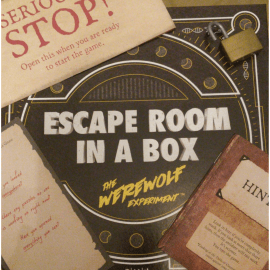 I’ve been an escape room freak for almost two years now, and have posted about why they’re such great experiences. I have to admit that I was a little skeptical at the idea of trying it at home, but I’ve been surprised and pleased at how much fun my friends and I had when we tried it. Last weekend, we played a game called “The Werewolf Experiment”, which promised, correctly, that we could just open the box and start playing. The instructions were easy to follow, the puzzles were challenging but doable, and while we had to look in the hints booklet twice (three times was the game’s suggested maximum), we never had to get into the answer book (although we were glad it was available, just in case). When we unlocked the last box, everyone cheered.
 This is another case where each player can only play once, but the game can still be reused. This particular game has PDFs on their website to allow you to print new copies of the consumable puzzles, and detailed instructions for putting everything back together. I’m planning on taking it to my parents’ house for our next family get together, so they can play while I control the hints and add to the atmosphere. Two of my friends have asked to borrow it to do the same with other groups of people, so we’re definitely getting our money’s worth. When we considered that the game cost just over $20, and most physical escape rooms cost about that much per person, we all agreed that it was worth the cost for just one play…and then we ordered three more.

What are your favorite games? Who do you play with (or plan to play with)? What are some ways to make game nights even more awesome? Let’s talk!
 With the exception of the occasional formal event, I never carry a bag that isn’t big enough for a paperback or my Kindle. Or both. Usually both. You never know when you’re going to end up with some unexpected free time, and that’s a great time to get your reading in. Waiting rooms, grocery store lines, arriving somewhere early…it’s hard to realize how much wait time we tend to have unless we’re actively looking at it. I know I accumulate at least half an hour every week just waiting for someone to arrive so we can start a meeting (especially since I’m terminally early, and sometimes other people…aren’t). When I started my first “real job” in my early twenties, people in the office had such different schedules that I usually ended up going to lunch alone, and reading at lunch became a lifelong habit (unless I’m with someone else, of course). You’ll also always be prepared for the unexpected, like waiting six hours for your car to get fixed after you threw a rod halfway through a four hour drive…just as a totally (not) hypothetical example. Keep your reading material close at hand, so you never miss a chance to get in a few pages.
 If your reading opportunities tend to be in shorter chunks, or you’re not sure about diving into a novel, you might consider a collection or anthology. Short story, essay, and poetry collections are perfect for bite sized reading, and help you further refine your tastes. They can also be great for discovering new authors and new interests. Some of my very favorite authors I first read in a collection.
  If you have decided that reading more is something you want to do, then be sure to keep that desire in the front of your mind. It’s easier to find time for the things we want to do, and the things we consider important. You can set a specific time (even on my busiest days, I always read for at least half an hour before bed) or a daily goal. Try playing around with your downtime by replacing something you normally do with a little bit of reading, and see how that works for you. If you (like me) are always making to do lists, then add your reading to the list so you don’t forget, and can have the satisfaction of crossing it off as accomplished.
 Reading is going to be more interesting if you follow your interests. I read mostly fiction, but I do keep an eye out for nonfiction about things that genuinely engage me. Are you a movie fan? Consider a biography of a favorite director, a book or article going behind the scenes of a favorite film, or maybe a book about cinema history. If you watched a documentary or took part in a conversation on a topic that piqued your interest, dig a little deeper on the subject. I’m a longtime circus fan, and that interest has led me to read a lot about circus and carnival history (which, by the way, is a fascinating subject). If you’re looking for a starting point, try a collection of essays (I frequently recommend
  Focusing on your interests also helps when selecting fiction. My aforementioned interest in the circus led me to


 Music is one of my favorite ways to keep myself in a positive headspace. Listening to a favorite song, especially if it’s upbeat, is one of the fastest ways to give yourself a boost. I have a happy mix (
 That one always works for me, anyway.
  Studies have proven time and again that interacting with others is very important for emotional health. While face to face conversation has the highest benefit, according to current research, phone calls and electronic communication also fill our need for socialization. A quick chat, email, online dialogue, etc. creates an instant mood boost, so when you want to get out of a funk, take a few minutes for some human connection. I talk to my mom and my best friend every morning (even if it’s only a brief exchange) to start the day off right, and go straight to one of them if I’m feeling unhappy.

 I don’t do rush hour. I will do just about anything to avoid traffic jams, including leaving early, staying late, and taking circuitous routes that cover a lot more distance than the crowded highways. When I’m in the car, I want to be moving. However, for the next few days I’m in off site meetings at a location about 40 miles away, on a timetable that means I’ll be in morning and evening rush hour traffic. I am trying to see it as a test of my patience and positive attitude.



 A while back, during lunch with some coworkers, we got to discussing family gatherings. It was an interesting conversation, because it turned out that almost everyone was frustrated by the things their family did, and didn’t, discuss, but for very different reasons. Here’s a summary:
 I don’t like shopping, but when my sister Audrey occasionally asks me to tag along and give my opinion, I do so with a smile. Why? Because I love my sister, and she wants me to share in an activity she enjoys. It’s the same reason that Audrey has accompanied me to a couple of fantasy and science fiction conventions. And, because we both approach each other’s activities with a positive attitude, we’ve both had more fun than we might have expected.
 Knowing what your friends and family prefer to avoid in their day to day lives can give you lots of opportunities to be helpful and caring. My dislike of shopping is universal, and I used to absolutely dread going to the grocery store. When my sister Amy and I shared an apartment, she always took care of it, because she knew I couldn’t stand it. When Amy moved out, a friend of mine, remembering my aversion to this task, volunteered to do my shopping for me, since we lived relatively close. For him, it was a small thing. For me, it was huge.
 One of my former supervisors always called me the “go-to girl”, and it wasn’t always a bad thing. He was great about showing appreciation both privately and publicly, especially in front of the higher ups. However, anytime he opened a conversation with this compliment, I knew he was about to hit me with something work intensive, last minute, or both. My personal favorite was calling me ten minutes before the end of the day and asking if I could give a presentation the next morning. (I said “yes” immediately, and ended up working all night to prepare.) It took a long time for me to learn to stop and think before I let the glow of pride overcome my ability to think through what I was actually being asked to do.
 My friend Mike works in IT, and he’s always on alert when someone opens a conversation, or abruptly changes the subject, with “You know so much about computers”. He told me that as soon as he hears this sentence, he immediately starts trying to decide if he has the time and/or inclination to help the speaker with a problem, because 99% of the time they’re about to ask. I’m not suggesting that you should never say “yes” in a situation like this (I’m actually a big fan of being helpful), but again, you need to stop and make sure you’re making the right decision.
 I will never forget one of my friends following “I know I can trust you” with a confession that he was having an affair with a married woman. She was also a friend, and so was her husband. He wasn’t looking for my opinion (although he received it, and then some), but just wanted to tell me about the relationship. Asking me to keep that information to myself was completely unfair, and since then I’ve been much more careful about becoming a secret keeper.
 A former friend was constantly late, frequently changed plans, and often wanted me to go places and do things she knew I wasn’t comfortable with. In her mind, flexibility is the highest virtue…in other people. I try to be easy-going, but believe me, I have my limits. After growing increasingly frustrated with her constant expectation that I would be fine in all circumstances, I tried talking to her several times, but the situation never improved. Ultimately, we drifted apart.

 Peter’s internal conflict is intensified by pressure from several sources, including Nick Fury (and let’s be honest…I don’t think many of us would be able to argue with Nick Fury). However, he gets some other things to think about when he meets a new hero: a competent, determined, adult hero who embodies everything Peter admires, and urges him to make his own choices and decide what he wants, which is a marked contrast to the messages he’s receiving from everyone else. One of the most effective things the Spider-Man reboot has done is to embrace the coming of age element of the young Spider-Man stories.
 One thing I really loved was MJ. While the nickname is, of course, an homage to the character of Mary Jane Watson, Michelle Jones is very, very different, and the character change was a great idea. The first Spider-Man trilogy introduced Mary Jane Watson as an unattainable girl that Peter patiently loves from afar until she finally has a reason to notice him and accept his worth. That’s a trope that has, frankly, overstayed its welcome. Far From Home‘s MJ is intelligent, competent, and assertive, and pays attention to everyone around her, including Peter. He isn’t in a position of having to prove himself to her; she already recognizes his admirable qualities. It’s a very different dynamic from the “nerd loves the prom queen” scenario, and it makes for a much better story.
 There was a lot going on in this movie, and I honestly think it tried to do a little too much. Some important things were simply not developed enough, which turned a few potentially interesting elements into little more than plot devices. Some of the events feel thrown in for no reason other than to justify something the filmmakers really wanted to include, or force a delay in something that otherwise would otherwise happen earlier. It clutters the movie, and makes some plot points just seem annoying and contrived.
 That idea of just accepting it and moving on is really at the center of everything else I didn’t love about the movie. There is technology that is explained just enough to make you question if it really could function as portrayed in a pivotal scene.
 Amanda Cade